Safeguarding Adults Policy and Procedures
Safeguarding Adults Policy and Procedures
| Policy Lead: | Safeguarding Lead/Registered Manager – Tavleen Sharma |
| Version No: | 1.0 |
| Date of issue: | September 2024 |
| Date to be reviewed: | September 2025 |
| Signed: | TAVELEEN SHARMA |
The aim of this policy is to ensure that all employees of VCare Consultancy Services Limited understand their responsibilities in relation to safeguarding. To achieve this, it is essential that all employees are fully aware of what constitutes abuse, as well as the potential indicators that abuse may be occurring.
Employees must also be fully aware of how to report concerns, recognise the importance of doing so immediately and understand the procedures through which to do this. This policy provides the information employees will require to fulfil their duties and obligations in respect to safeguarding service users.
All employees are expected to raise any concerns regarding the possibility of abuse at the earliest opportunity. VCare Consultancy Services Limited encourages and fosters a culture of open and honest enquiry regarding any of your concerns and employees should feel supported in being able to share their concerns.
Emergency services support is to be sought if risk is imminent to a person or if an individual assessing is unsure of the risk to a person.
VCare Consultancy Services Limited operates within Bristol City Council, South Gloucestershire Council, Somerset Council and Bath & Northeast Somerset Council jurisdictions.
If an employee suspects a potential safeguarding issue has been committed against an adult, it is their responsibility to liaise with the local authority safeguarding team/safeguarding lead immediately.
The Safeguarding Lead for VCare Consultancy Services Limited is the registered manager Mrs Tavleen Sharma – Contact details:
Contact details for the local safeguarding team can be found below:
Bristol City Council –
https://bristol.gov.uk/residents/social-care-and-health/adults-and-older-people/report-suspected-abuse
Tel: 01454 615165 Text phone: 60066
South Gloucestershire Council –
http://sites.southglos.gov.uk/safeguarding
Tel: 01454 868007 – Monday to Friday 9am – 5pm
01454 615165 – Out of hours and at weekends
Somerset Council –
Report an adult at risk (somerset.gov.uk)
Phone: 0300 123 2224
Email: adults@somerset.gov.uk
Bath & Northeast Council –
https://bcssp.bathnes.gov.uk/contact-us-0
Office hours: 01225 394200
Out of hours (evenings weekends and bank holidays): 01454 615165
A referral MUST be made immediately to the local authority safeguarding team based on where the adult at risk is located.
The NHS Safeguarding app can also be used to achieve this, details for downloading the app can be found here NHS England » NHS England Safeguarding app.
VCare Consultancy Services Limited has a legal responsibility to prevent adults from abuse, harm, or neglect (including self-neglect) and to act positively to report concerns.
We will take all reasonable steps to prevent harm, to protect people and to respond appropriately when harm does occur.
This policy and the procedures apply to all employees, including workers and independent sub- contractors.
VCare Consultancy Services Limited are required to have a Safeguarding Lead responsible for guiding and supporting employees when dealing with the safeguarding of adults.
This decision-making tool will be used prior to a safeguarding being raised and is designed to ensure adults at risk can access the right support at the right time and responses to concerns are appropriate and proportionate.
Under section 42 of The Care Act 2014 the following three stage test will be applied to all reported safeguarding concerns:
Has needs for care and support (whether or not the local authority is meeting any of those needs) and;
As a result of those care and support needs, is unable to protect themselves from either the risk of, or the experience of abuse or neglect.
An adult who meets these criteria is referred to as “an adult at risk”. Safeguarding duties also apply to family carers experiencing intentional or unintentional harm from the adult they are supporting or from professionals and organisations that they are in contact with.
The below sets out action to take depending on the abuse concerned:
Report - If the adult/s have been seriously harmed or at risk of serious harm because of actions, or omissions, deliberate or unintentional of others, then report as a safeguarding concern to the local authority named within this policy. If there is indication that a criminal act has occurred, and the matter is urgent, contact the Police.
Consult - Moderate risk and or moderate care and support needs. Concerns at this point may be reportable and must be considered on a case by case basis. The adult's views must be considered. Advice should be sought from the Safeguarding Lead or the Local Authority Safeguarding Team.
Resolve - Low risk or care and support needs where all actions to prevent abuse or protect an adult from abuse are recorded. The adult's needs are met through local support services accessed via appropriate referral routes. A level of concern that can be resolved through care management, complaints, staff training, case reviews, quality processes or contract management.
As a part of our commitment to preventing safeguardings and protecting people from abuse, VCare Consultancy Services Limited will adhere to the 6 key principles of safeguarding outlined in the Care Act 2014:
Empowerment is the principle that adults should be in control of their lives and consent is needed for decisions and actions designed to protect them.
The purpose of safeguarding is to enable people to live a life free from abuse and neglect. It is, therefore, vital that if an individual has mental capacity and is able to make their own decisions that they maintain control of their life and that professionals support their decision-making throughout the process. This includes:
In the event that an individual is without the mental capacity to make a particular decision for themselves, a Best Interests Meeting should take place and a decision should be made in the best interest of the individual and within the framework of the Mental Capacity Act 2005 and Code of Practice. The individual should continue to be fully involved in the decision-making process and any decisions made must recognise their wishes, feelings, beliefs and values and ensure that they are appropriately represented.
Safeguarding Adults procedures provide a framework by which adults can be supported to safeguard themselves from abuse, or are supported and protected, where they are unable, for reasons of mental capacity, to make decisions about their own safety.
Assessments of mental capacity and best interest decisions, in relation to those without mental capacity, must always be within the legal framework of the Mental Capacity Act 2005 and Code of Practice. Protection encompasses every person’s duty of care and/or moral responsibility to act upon suspicions of abuse, within the context of this procedure, and ensure that adults at risk as citizens receive the protection afforded them in law.
Prevention of abuse is the primary goal, and members of the public, agencies, service providers, individual employees or volunteers and communities all have a role in preventing abuse from occurring. Prevention involves promoting awareness and understanding and supporting people to safeguard themselves from the risk of abuse. This includes helping people to identify and make informed decisions about risks and develop forward plans that keep them safe.
Prevention also refers to the actions of organisations to ensure they have systems in place that minimise the risk of abuse. Prevention is associated with a broad range of responsibilities and initiatives, each associated with making safeguarding adults a core responsibility within the context of providing high quality services.
The principle of proportionality relates to the responsibility to ensure that responses to safeguarding concerns are proportional to assessed risk and the nature of the allegation/concern. Proportionate decisions need to consider the principles of empowerment and protection.
This principle of proportionality is also encompassed within the Mental Capacity Act 2005; where an individual lacks mental capacity to make a particular decision, decisions must be made in the individual’s ‘best interests’. This includes the responsibility to consider if the outcomes can be achieved in a way that is ‘less restrictive of the person’s rights and freedoms.
Partnership means working together to prevent and respond effectively to incidents or concerns of abuse, to support the adult at risk in making informed decisions about identified risks of harm and helping them to access sources of support that keep them safe.
Partnership also includes working with relatives, friends, unpaid carers or other representatives, such as advocates as partners, as appropriate, to achieve positive outcomes for the adult at risk.
Partnership also means working cooperatively with other agencies to prevent, investigate and end abuse. Statutory, private, voluntary and specialist or mainstream services and their representatives should be considered partners within this procedure.
The principle of accountability involves transparency and decision making that can be accounted for. This involves each individual and organisation fulfilling their duty of care, making informed defensible decisions, with clear lines of accountability. It involves companies, employees (and volunteers) understanding what is expected of them, recognising, and acting upon their responsibilities to each other, and accepting collective responsibility for safeguarding arrangements.
To meet our commitment, VCare Consultancy Services Limited will:
Abuse is the violation of an individual’s human and civil rights. Abuse can be self-inflicted or inflicted by another person or persons. In the context of safeguarding, it is used to refer to any knowing, intentional, or negligent act by another that causes harm or a serious risk of harm to another. The Care Act recognises ten categories of abuse experienced by adults as follows, although it is important to also recognise that cyber bullying, forced marriage, mate crime and radicalisation can also apply to adults:
Use of physical force or mistreatment of one person by another, which may or may not result in actual physical injury; physical injuries which have no satisfactory explanation or where there is a definite knowledge or reasonable suspicion that the injury was inflicted with intent, or through lack of care, by the person having custody, charge or care of that person. This could include:
Possible indicators of physical abuse include:
Any behaviour which is unwanted or takes place without consent or understanding. Sexual abuse can take many forms and may include:
Possible indicators of sexual abuse could include:
Psychological or emotional abuse is behaviour that is psychologically harmful or inflicts mental distress.
Possible indicators of psychological or emotional abuse include:
Actual or attempted theft fraud or burglary. Misappropriation or misuse of money, property, benefits, material goods or other asset transactions which the person did not or could not consent to or which were invalidated by intimation coercion or deception – this could include:
Organisational or institutionalised abuse can occur in any organisation when the routines in use force individuals to sacrifice their own needs, wishes or preferred lifestyle to the needs of the institution or service provider.
Abuse may be a source or risk from an individual or by a group of employees embroiled in the accepted custom, subculture and practice of the institution or service. It involves the collective failure of an organisation to provide safe appropriate services and includes failure to ensure necessary preventative or protective measures are in place. Possible indicators of institutional or organisational abuse include:
Institutions may include residential and nursing homes, hospitals, day centres, sheltered housing schemes and group or supported housing projects. It should be noted that all organisations and services, whatever their setting, can have institutional practices which can cause harm to vulnerable adults.
The distinction between abuse in institutions and poor care standards is not easily made and judgements about whether an event or situation is abusive should be made with advice from appropriate professionals and regulatory bodies.
Can be both physical and emotional. Neglect occurs when a person deliberately withholds or fails to provide, appropriate and adequate care and support which is required by another person. It may be through a lack of knowledge or awareness, or through failure to take reasonable action given the information and facts available to them at the time.
Neglect of a Duty of Care or the breakdown of a care package may also give rise to safeguarding issues, for example where a care provider is unable/unwilling to meet the assessed needs. Possible indicators of neglect include:
Wilful neglect means the deliberate failure to do something that was a duty, often with an element of recklessness. It does not require any proof of any particular harm or distress or proof of the risk of harm.
Ill-treatment involves deliberate conduct which ill-treats a person who lacks mental capacity to make the relevant decisions, whether or not it causes any harm to them. Ill-treatment also involves a guilty mind, with the abuser having an appreciation that he or she was inexcusably or recklessly ill-treating the person.
Most indicators of the other types of abuse may also indicate wilful neglect or ill-treatment so these two offences should always be considered with each allegation.
Self-neglect is failing to care for one’s personal hygiene, health or surroundings in such a way that causes, or is likely to cause significant physical, mental or emotional harm or substantial damage to or loss of assets. Self-neglect differs from the other forms of abuse because it does not involve a perpetrator. Self-neglect can happen as a result of an individual’s choice of lifestyle, or the person may have a mental health condition, such as depression, poor physical health, cognitive difficulties or misuse substances. Possible indicators of self-neglect include:
Domestic abuse is the abuse of one person within an intimate or family relationship. It can be the repeated, random or habitual use of intimidation to control, coerce or threaten a person. The abuse can encompass, but is not limited to physical, emotional, psychological, financial, sexual, honour-based violence, female genital mutilation or forced marriage.
Domestic abuse can also involve the abuse of a person at risk. Safeguarding procedures only apply in this instance where the person:
Honour Based Violence (HBV) is a crime of incident which has or may have been committed to protect or defend the honour of a family or community. It is a collection of practices used to control behaviour within families or other social groups, to protect perceived cultural and religious beliefs and/or honour. Such violence can occur when a relative has shamed their family and/or community by breaking their honour code. Possible indicators of honour-based violence include:
Female Genital Mutilation (FGM) is sometimes referred to as female circumcision. It refers to procedures that intentionally alter or cause injury to the female genital organs for non-medical reasons. This practice is illegal in the UK. Possible indicators of Female Genital-Mutilation include:
Modern Slavery encompasses human trafficking, domestic servitude and forced labour. Traffickers and slave masters use whatever means they have at their disposal to coerce, deceive and force individuals into a life of abuse, servitude and inhumane treatment. Possible indicators of Modern Slavery include:
Discriminatory abuse is abuse targeted at a perceived vulnerability or on the basis of prejudice including racism or sexism, or based on a person’s impairment, origin, colour, disability, age, illness, sexual orientation or gender.
Hate Crime can be one-off or multiple criminal offences that are perceived, by the person at risk or any other person, to be motivated by hostility or prejudice based on a person's vulnerability or perceived vulnerability. They can manifest as the other types of abuse, including physical, sexual, financial, neglect and psychological abuse. Examples can include:
Possible indicators of discriminatory abuse and/or hate crime are the same as those outlined above for other types of abuse.
Mate Crime is the premeditated exploitation, abuse or theft from people with a Learning Disability, by those they consider as their friends. However, it also applies to older adults, for example, those with a mental health problem or sensory impairment.
It can encompass other types of abuse, such as physical, psychological, sexual or financial. Examples can include being physically harmed for the amusement of others, having benefits or food stolen or being coerced into crime or prostitution. Possible indicators of mate crime include:
Radicalisation is the process by which a person comes to support terrorism and forms of extremism leading to terrorism. Radicalisation is not officially classed as a type of abuse, however, it is important to include it to raise awareness.
Key vulnerabilities such as Learning Disabilities, Mental Health problems or autism can increase an individual’s susceptibility towards radicalisation and to be influenced be extremism (Home Office, 2011). Possible indicators of radicalisation include:
Safeguarding adults means:
Where an individual believed to be at risk of abuse is encountered or if an individual discloses or discusses potential abuse with you, it should be recognised that the individual may be describing abuse, albeit not explicitly. You must stay calm and show empathy, reassuring them that the information is being treated seriously. Following the identification of a safeguarding concern, employees are responsible for:
It is essential to ensure that the individual at risk of abuse remains at the centre and involved in the safeguarding process, accounting for the views wishes, feelings and beliefs and individuals should be offered to have a family
member, friend or advocate, if appropriate and desired, to be present during any discussions on safeguarding. Employees will have been considered to have reasonably met their duty of care when:
Any assessment of any safeguarding concern should be holistic and thorough considering the individual’s emotional, social, psychological and physical presentation as well as the identified clinical need. When discussing/assessing a safeguarding issue with an individual:
All safeguarding concerns must be immediately raised to the Safeguarding Lead who will review and consider whether a safeguarding referral is appropriate.
Where there is any doubt, the Safeguarding Lead should discuss this further with suitable colleagues before making a decision.
Before making a safeguarding referral, the Safeguarding Lead should ensure the service user fits the statutory criteria for an adult at risk (as defined under the 3-Stage Test section of this Policy) and assess their mental capacity to consent to the referral (see Mental Capacity Act Policy for further information).
If a service user lacks capacity to make a decision about a safeguarding referral, it is acceptable to refer them in their ‘best interests’. An individual of capacity has the right to refuse consent, in this situation the risk of doing so must be fully explained.
Additionally, if the service user refuses consent for a safeguarding referral the Safeguarding Lead must consider whether there is an overriding public interest that outweighs individual service user confidentiality, for example, other people could be at risk, a possible crime has been committed or there is a risk to the health and safety of others. Where the adult at risk criteria does not apply, service user with capacity refuses consent and there is no overriding public interest disclosure a safeguarding referral may not be appropriate. In these instances, the Safeguarding Lead and treating staff should consider any other actions required to support the needs of the adult or other actions, such as complaints processes, training needs or regulatory action if appropriate.
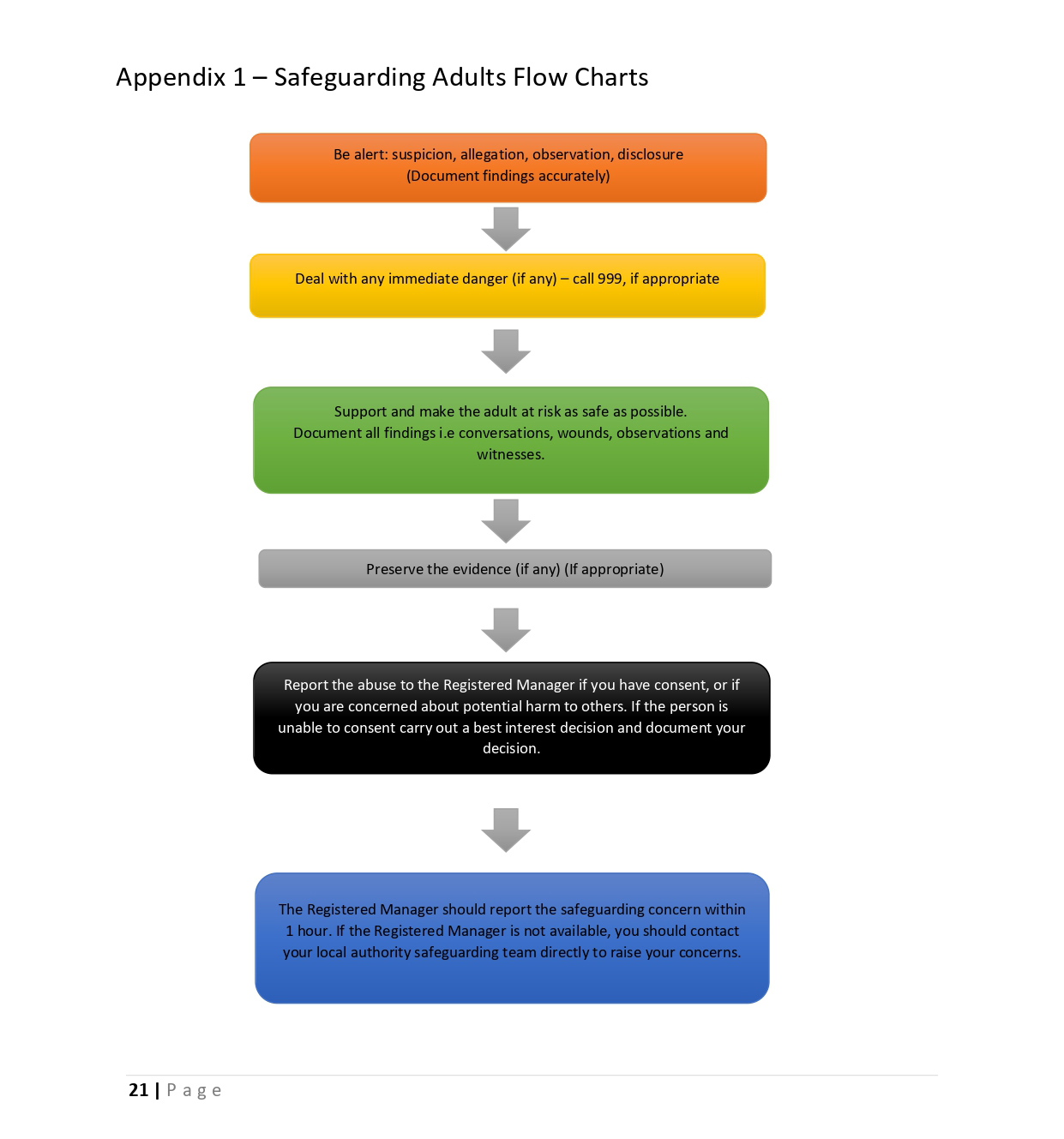
Please see the flow chart in Appendix 1 for further information.
Mental Capacity Act
An individual of capacity has the right to refuse consent, in this situation the risk of doing so must be fully explained. If there is a concern over the individual’s mental capacity, an assessment should be performed in line with the guidelines of the Mental Capacity Act 2005 and the Mental Capacity Policy.
Information sharing between organisations is essential to safeguard adults at risk of abuse, neglect and exploitation. In this context ‘organisations’ mean not only statutory organisations but also voluntary and independent sector organisations, housing authorities, the police and Crown Prosecution Service, and organisations which provide advocacy and support.
Decisions about what information is shared and with whom will be taken on a case-by-case basis by the Registered Manager in consultation with the Data Protection Officer in line with VCare Consultancy Services Limited’s Confidentiality and Information Governance Policies.
A record must be kept of all decisions made in relation to information sharing, whether the information is shared or not. If a decision has been made to share information, a record must be kept of what was shared, with whom and for what purpose. Any information disclosed should be:
Under Section 26 of the Counter-Terrorism Security Act 2015, healthcare professionals have a duty to have ‘due regard to the need to prevent people from being drawn into terrorism’. The Prevent strategy aims to reduce the threat of terrorism by preventing people from becoming terrorists or supporting terrorism and has three strategic objectives:
VCare Consultancy Services Limited will ensure that all employees understand and can comply with this duty through the implementation of mandatory prevention of radicalisation training. Employees will be expected to demonstrate:
As a part of this strategy employees are also responsible for being:
Changes to an individual’s behaviour indicative of potential radicalisation should be assessed for their reliability and significance by considering any:
If employees are concerned that an at-risk individual is being exploited, they should raise their concern with the Registered Manager and/or the Safeguarding Lead who will then consider referral to the relevant Local Authority or Regional Prevent Coordinator. Factors that can contribute toward an individual’s vulnerability and subsequent risk of radicalisation include:
The same principles of safeguarding apply whether staff are interacting with or carrying out services for service users in person or remotely. However, employees should be aware that identifying adults at risk of abuse may be more difficult in a remote environment. If there are any concerns as to the welfare of the adult, consideration should be given as to whether the remote service is an appropriate approach in that situation. Any concerns should be referred to the Safeguarding Lead for advice and assistance.
VCare Consultancy Services Limited will not tolerate any employee, worker or other person engaged to support or provide services to, or on our behalf to have:
Any employee identified to behave in such a way as to indicate one or more of the above statements, either within their work or because of actions within their personal life, may be subject to disciplinary action. Identification of such incidents can come from various different sources. VCare Consultancy Services Limited will take prompt action to investigate any allegations made and will take any actions necessary to protect individuals and those that work with us, for us, and on our behalf.
Resultant actions can/may include an employee being suspended and possibly dismissed. All allegations will be reported to the CQC without delay, as is required. Where the allegation is made against a healthcare professional we will liaise with and report to the relevant professional body.
Additionally, VCare Consultancy Services Limited has a duty to refer employee(s) to the Disclosure and Barring Service (DBS) if they have:
A relevant offence for the purposes of referrals to DBS is an automatic inclusion offence as set out in the Safeguarding Vulnerable Groups Act 2006 (Prescribed Criteria and Miscellaneous Provisions) Regulations 2009 and the Safeguarding Vulnerable Groups.
Broadly speaking these offences include all sexual offences, all offences involving children, most prostitution offences and murder. If you are unsure, contact the HR Department for guidance.
If the above conditions have been met and the Registered Manager will conclude that the investigation conducted shows that the employee(s) concerned has a case to answer, a referral must be referred to DBS.
The Safeguarding Lead is responsible for notifying the CQC, as soon as reasonably possible, of abuse or allegations of abuse concerning a person using the service if any of the following applies:
Not all referrals made to the local authority need to be notified to CQC. The Company is only required to notify CQC of safeguarding incidents where the allegation of abuse is linked to the Company’s provision of care.
All persons associated with and third parties working or volunteering with VCare Consultancy Services Limited will be required to undertake an induction that includes mandatory training on the safeguarding of adults as well as the Prevent strategy for radicalisation.
This will then need to be updated at least every 2 years.
The Safeguarding lead will monitor, where applicable:
Consent Policy and Procedures Confidentiality Policy and Procedures
Training and Development Policy and Procedures
Equality and Diversity and Human Rights Policy and Procedures Information Governance Policy and Procedures
Mental Capacity Act and DoLS Policy and Procedures Confidentiality Policy and Procedures
Recruitment Policy and Procedures Whistleblowing Policy and Procedures Freedom to Speak Up Policy and Procedures
Ann Craft Trust: https://www.anncrafttrust.org/resources/a-guide-to-safeguarding-adults/ Care Act 2014
Care Quality Commission: https://www.cqc.org.uk/sites/default/files/20150710_CQC_New_Safeguarding_Statement.pdf Equality Act 2010
Gov.uk: www.gov.uk/government/publications/safeguarding-adults-the-role-of-health-services Home Office: Revised Prevent duty guidance: for England and Wales 2019:
https://www.gov.uk/government/publications/prevent-duty-guidance/revised-prevent-duty-guidance-for- england-and-wales
Mental Capacity Act 2005 Modern Slavery Act 2015
NICE Guidance: https://www.nice.org.uk/guidance/health-and-social-care-delivery/safeguarding Public Interest Disclosure Act 1998
This checklist is to assist you to have the right information when you are raising a safeguarding adult concern. We know that it is often a stressful conversation, and you may forget vital information when you make the call. Do not worry if you do not have all the information below. Concerns will always be considered when some of this information is not available. | |
Name of Alerter (You can remain anonymous) | |
Contact details of Alerter | |
Relationship to Victim | |
Organisation of Alerter | |
Name (of adult at risk) | |
Address of Adult | |
Address, if different, of place of alleged abuse | |
Contact details of adult at risk | |
Details of Category of Vulnerability (Older, frail, Mental Health, Learning Difficulties etc.) | |
Date of Birth or Age | |
Gender | |
Ethnicity | |
Religion | |
Capacity and understanding | |
Communication needs (sensory loss, language, other) | |
Name of Alleged Perpetrator | |
Address of Alleged Perpetrator | |
Date of Birth of Alleged Perpetrator | |
Details of Referral - You need to consider the following so that the person taking the referral decision can gain adequate information | |
Nature of abuse/incident | |
When did it happen? | |
Where did it happen? | |
Was anyone else involved? | |
Was the incident witnessed? | |
Have you had previous concerns regarding this person? If so, what? | |
Does the adult at risk of abuse or neglect know you are making this referral? | |
What does the person want to happen? | |
Have you done anything to assist the adult at risk at this time? (What actions have been taken?) | |